Saturday, 9 May 2015

Retirees who opt to keep mortgage payments-By Anya Martin


Mortgage
Thinkstock
Maybe their parents paid off the house before retiring, but many baby boomers today say it makes more sense to carry a mortgage.
The game-changers: low interest rates and high stock-market returns. Older Americans may come out ahead by keeping 401(k)s and other holdings invested rather than cashing out to make a house payment, says Tom Wind, executive vice president of home lending at Jacksonville, Fla.-based EverBank.
Improved health care and life expectancy also play a role, says Ken Dychtwald, president and CEO of Age Wave, a consultancy focusing on aging trends. “Today when people reach 60 or 65, they come to realize they may have decades of life in front of them,” he says. “When their mom and dad reached retirement, they felt they were in the last inning and needed to pick the safe path.”
Reflecting that more active, long-range perspective, 64% of today’s retirees say they are likely to move at least once, according to a study released in February by Merrill Lynch and Age Wave. Of these, 37% have already moved and 27% anticipate doing so.
They also aren’t necessarily downsizing, either. In fact, 30% of moving retirees relocated to larger homes, the Merrill Lynch/Age Wave study found. Top reasons for a larger home included enough room for family members to visit (33%) and a “boomerang” child living with them (16%). The results are based on the responses of 3,638 participants age 21 and older in a survey conducted in August.
Many older home buyers have the means to pay all cash, but either on the advice of their financial adviser or their own decision, they choose to take out a loan, says Peter Grabel, managing director of Stamford, Conn.-based Luxury Mortgage.
Typically when someone 70 years old calls him for financing, it’s an investment choice, Mr. Grabel says.
The biggest challenge for prospective retiree borrowers is that underwriting rules favor income over assets, Mr. Wind says. In other words, they need to show they can make monthly payments without cashing out investments.
Some retirees head off the income issue with sufficient pension payments and by scheduling distributions of their retirement assets, Mr. Wind says. In some cases, a lender may qualify a borrower based on assets amortized over the lifetime of the loan, he adds
But a rising number have job income as well from second careers that may begin over 50, Mr. Dychtwald says.
“We often think of entrepreneurs being that young tech whiz, but more often it’s a 60-year-old taking that idea and investing in it.”
While the math might seem to favor borrowing, retirees should still keep in mind that the risks of carrying debt multiply for older borrowers, says Michael Abbott, CFO of the Abbott Bennett Group, a Concord, N.H.-based financial adviser. While the stock market has been on a bull run for the past five years, that run won’t last forever, he adds.
“If you have the income coming in to make your mortgage payment, then you could potentially weather the storm,” Mr. Abbott says. “But if you are using your asset to pay down the mortgage and that asset has a downturn, you may need to sell your house to pay down the mortgage.”
If a stock market drop is coupled with a health or other high-cost emergency, the financial hit can be even harder, he adds.
Here are a few more things retirees may want to know when weighing a mortgage:
• Put more down. Like all home buyers, retirees want the best interest rates. Since they have cash and assets, many are often willing to make a larger down payment to get a low rate, Mr. Grabel says.
The 30-year, fixed-rate jumbo had an average interest rate of 3.89%, and the five-year, adjustable-rate jumbo averaged 2.88% for the week ending May 1, according to HSH.com, a mortgage website.
• No age restrictions. If a borrower can show the income to qualify for a mortgage, lenders aren’t permitted by federal law to consider either age or health status in the qualification process, Mr. Grabel says. He just had an 89-year-old client approved for a 30-year, fixed rate mortgage, for example. Unfortunately, that borrower died before the closing, he adds.
• Not just math. Retirees should weigh not just returns but their risk comfort level, says Christopher M. Bennett, CEO of the Abbot Bennett Group. “There’s still something about that good old-fashioned American dream,” he adds. “Making sure the money is there and paying off the house is very rewarding to many people.”
Most retirees still prefer to own their home debt-free. Of Americans age 65 and over, 72% of homeowners have fully paid off their mortgage, according to the U.S. Bureau of Labor Statistics. However, a decade ago, 79% were home debt-free.

Culled from The Wall Street Journal

Friday, 8 May 2015

Lawsuits pile up over Pacquiao injury-By Rebecca Bryan


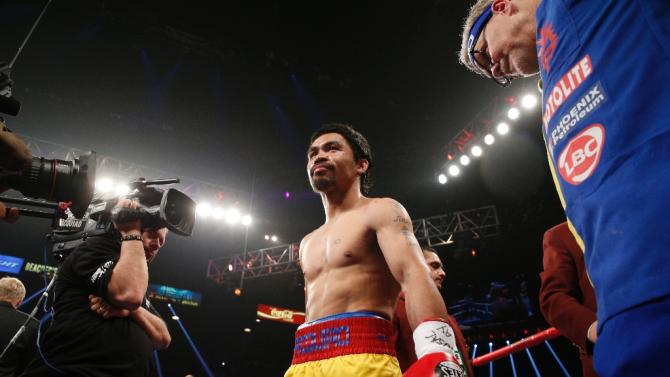
Manny Pacquiao arrives in the ring for his welterweight unification championship bout with Floyd Mayweather on May 2, 2015 at MGM Grand Garden Arena
.
.
Los Angeles (AFP) - More disgruntled fight fans are going to court with their complaints, suing Filipino ring icon Manny Pacquiao and others for failing to disclose a shoulder injury prior to his "Fight of the Century" against Floyd Mayweather.


A class-action suit filed in US District Court in Illinois not only names Pacquiao and promoters Top Rank but also telecasters HBO and Showtime, who combined to produce the pay-per-view fight program that was sold in the United States for about $100.
The suit also names Mayweather, Mayweather Promotions and cable television providers AT&T, COMCAST and DirecTV, and accuses the defendants of deceptive practices in marketing and advertising the bout.
"Defendants, individually and collectively, deceptively and fraudulently promoted, produced and sold the fight as one between two healthy fighters... expressly misrepresenting the health of Manny Pacquiao to the Nevada State Athletic Commission, all in an effort to maximize and collect pay-per-view revenue," the lawsuit claims.
At least five such class-action suits have been filed across the United States, seeking millions of dollars in compensation on behalf of those who bought tickets, forked out pay-per-view fees or bet on Saturday's fight in Las Vegas, which Mayweather won easily on points.
Pacquiao revealed afterwards that he had been held back by the shoulder complaint.
It did not take long for the lawsuits to come flooding in.
- 'Dud of the century' -
Two men in Nevada sued on Tuesday, saying the promotion violated the state's Deceptive Trade Practices Act.
In a similar suit filed in California, plaintiff Howard B. Sirota cites former heavyweight world Champion Mike Tyson as calling the long-anticipated bout the "Dud of the Century."
Some of the lawsuits point to the pre-fight medical questionnaire signed by Pacquiao for Nevada boxing authorities in which he checked "no" to the question, "Have you had any injury to your shoulders, elbows or hands that needed evaluation or examination?"
Pacquiao adviser Michael Koncz, named as a defendant in some of the lawsuits, has said he inadvertently ticked the wrong box.
Daniel Petrocelli, an attorney for Pacquiao and Top Rank, told The Los Angeles Times that he was confident the Nevada lawsuit would be dismissed.
"It claims Pacquiao was injured (immediately) before the bout and that's not true -- he was injured (nearly a month) before the bout, was examined by doctors and cleared to fight," Petrocelli said. "And he was examined by the commission right before he fought."
ESPN reported Monday that Pacquiao's camp expect the fighter to undergo surgery for a "significant" rotator cuff tear.
They say they disclosed the injury suffered in training camp when they cleared the use of anti-inflammatory drugs with the US Anti-Doping Agency and that Pacquiao had improved enough to be cleared by doctors to fight.
Mayweather earned an emphatic, unanimous 12-round decision over Pacquiao in the feverishly anticipated bout that will go down as the richest in boxing history -- and by critics as one of the most overhyped.
Mayweather walked out of the MGM Grand Garden Arena with a check for $100 million -- just the first installment of a payday that could reach $200 million when all the pay-per-view sales, ticket sales, closed circuit TV viewings and other revenue is totted up and shared out.
Pacquiao is expected to receive more than $100 million.

Culled from AP

Thursday, 7 May 2015

Asia slides, euro at two-month peak as global bond rout rattles markets-Reuters


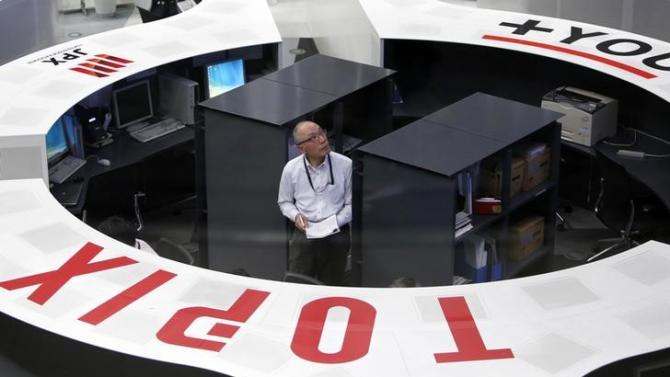
An employee of the Tokyo Stock Exchange looks at a stock quotation board as he works at the bourse at TSE in Tokyo
.
View photo
An employee of the Tokyo Stock Exchange (TSE) looks at a stock quotation board as he works at the bourse at TSE in Tokyo March 13, 2015. REUTERS/Yuya Shino
By Shinichi Saoshiro
TOKYO (Reuters) - Asian stocks fell on Thursday, led by losses on Wall Street, while a rise in euro zone debt yields amid a global bond rout kept the euro near a two-month peak versus the dollar, while the pound lost ground ahead of Britain's election later in the day.
The Conservative and the opposition Labour Party have been neck and neck in opinion polls that indicate Britain could be in store for a hung parliament and another coalition government.
The euro climbed as far as 74.49 pence (EURGBP=R), reaching a high last seen in mid-February. It was last at 74.41 pence.
Sterling was flat against the dollar at $1.5244 (GBP=D4). It has lost momentum after touching a two-month peak of $1.5498 last week.
Spreadbetters expected negative sentiment in equities to be retained in Europe, forecasting a slightly lower open for Britain's FTSE (.FTSE), Germany's DAX (.GDAXI) and France's CAC (.FCHI).
As European deflation fears have ebbed, a seeming reversal of trades linked to the European Central Bank's big quantitative easing has resulted in a sell-off in core European bonds and equities this week, rattling investors across asset classes.
MSCI's broadest index of Asia-Pacific shares outside Japan fell 1 percent as shares retreated in China, Hong Kong, Australia, South Korean and Malaysia.
The Shanghai Composite Index (.SSEC) was down 1.4 percent on fears of fresh moves by regulators to reduce leverage in stock trading, extending its losses so far this week to 6.1 percent. [.SS]
The index is still up an impressive 29 percent so far this year on expectations that China's policy easing would shore up equities. The steep gains, however, have triggered expectations of a sharp correction.
"Another few such declines and some of the millions of retail investors who have recently piled into the market might start to wonder if it really is a guaranteed way to make 30-40 percent returns every year or not," analysts at Rabobank wrote in a note.
Tokyo's Nikkei (.N225) lost 1.1 percent in its first trading day of the week. Japanese financial markets were closed from Monday to Wednesday for public holidays.
U.S. stocks ended weaker on Wednesday after U.S. Federal Reserve Chair Janet Yellen warned of high share valuations, adding to anxiety about future interest rates. [.N]
Weak U.S. indicators also added to uncertainty regarding when the first rate hike by the Fed could take place. Data on Wednesday showed tepid private job gains and a second straight quarterly decline in productivity. (ECONUS)
Shrinking expectations for an early rate hike - a tightening in June appears less and less likely - weighed on the dollar and helped its counterparts like the yen and euro.
The euro was steady at $1.1343 (EUR=), not far from a two-month high of $1.1371 struck overnight. The dollar stood little changed at 119.49 yen, pulling further away from this week's high of 120.51 touched on Tuesday (JPY=).
The euro continued to get support from a surge in euro zone bond yields, notably on German Bunds, in light of an easing in deflation fears thanks to improving European data.
German 10-year bond yields hit a four-month high of 0.595 percent overnight. Just last month it had hit a record low of 0.05 percent, when hopes were high that the ECB's trillion euro bond buying quantitative easing program would drive the yield into negative territory. [GVD/EUR]
French, Dutch, Belgian and Austrian equivalent bond yields also scaled 2015 peaks on Wednesday.
In addition to sending chills through financial markets worldwide, the retreat in euro zone bonds has also weighed on U.S. Treasuries and Japanese government bonds, pushing their 10-year yields to two-month highs.
"The focus is on whether ECB officials will express concerns over the euro's rebound and weaker European stocks, and whether that would halt the rise in Bund yields," said Masafumi Yamamoto, senior strategist for Monex, Inc. in Tokyo.
"The euro's bounce could stop if Bund yields steady, but without hints of further ECB easing it could be hard to keep the currency from rising again."
In commodities, U.S. crude slipped on profit taking following an overnight climb to 2015 peaks reached after a first drawdown in U.S. crude inventories since January. [O/R]
U.S. crude (CLc1) was down 0.7 percent at $60.53 a barrel after reaching a five-month high of $62.58 on Wednesday.
(Editing by Eric Meijer & Kim Coghill)
.