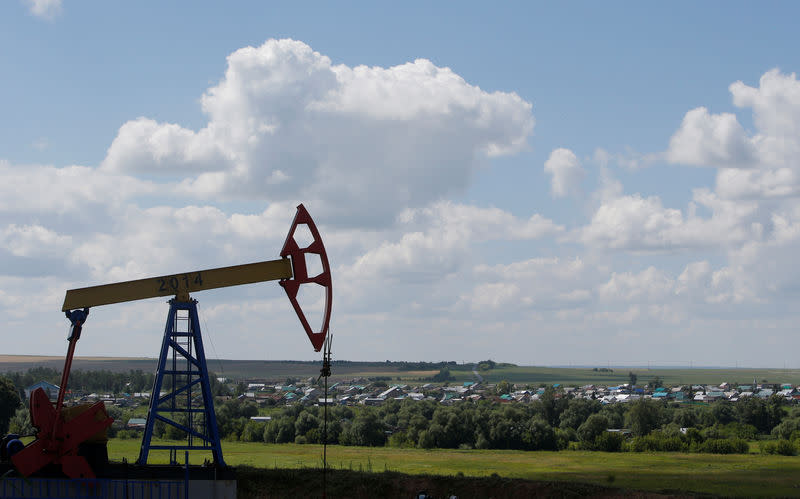
A
pump jack is seen at the Ashalchinskoye oil field owned by Russia's oil
producer Tatneft near Almetyevsk, in the Republic of Tatarstan, Russia,
July 27, 2017. REUTERS/Sergei Karpukhin/File Photo
By Henning Gloystein
SINGAPORE
(Reuters) - Oil prices fell on Wednesday, weighed down by concerns of
oversupply as Libyan output improves and as U.S. gasoline inventories
rose despite the peak summer driving season.
Brent
crude futures, the international benchmark for oil prices, were at
$51.75 per barrel at 0415 GMT, down 12 cents, or 0.2 percent, from their
last close.
U.S. West Texas Intermediate (WTI) crude futures were at $47.72 a barrel, down 11 cents, or 0.2 percent.
Libya's Sharara oil field, the country's largest, was gradually restarting on Tuesday after a shutdown.
Sharara
recently reached output of 280,000 barrels per day (bpd), but closed
earlier this month due to a pipeline blockade. Its production is key to
Libya's oil output, which surged above 1 million bpd in late June, about
four times its level last summer.
Libya's
rising output is a headache for the Organization of the Petroleum
Exporting Countries (OPEC), which together with non-OPEC producers
including Russia has pledged to hold back around 1.8 million bpd of
supplies between January this year and March 2018 to tighten supplies.
However,
OPEC has so far fallen short off its pledge, in part due to Libya's
strong output. The OPEC-member has been exempt from cuts.
"Sentiment
towards oil remains bearish amid oversupply fears and the possible
threat of OPEC's supply cut deal falling apart," said Lukman Otunuga,
analyst at futures brokerage FXTM.
The
next meeting of a ministerial committee of OPEC and non-OPEC states to
discuss their production pact has been proposed for Sept. 22.
In
the United States, crude inventories fell by 3.6 million barrels in the
week to Aug. 18 to 465.6 million, industry group the American Petroleum
Institute said Tuesday. However, gasoline stocks rose by 1.4 million
barrels, compared with analyst expectations in a Reuters poll for a
643,000-barrel decline.
Jeffrey
Halley, senior market analyst at futures brokerage OANDA said that the
rising U.S. gasoline inventories were "not a good sign during the U.S.
summer driving season" during which fuel demand tends to be high.
Official inventory data by the U.S. Energy Information Administration is due to be released late on Wednesday.
Meanwhile, Bernstein Research warned that low prices and ample supplies were resulting in low oil industry investment levels.
"We
see (oil and gas)... order intake activity at almost the same low level
as in 2016 ... For now, we remind investors that contract levels appear
to still be insufficient to drive recovery in earnings," it said.
(Reporting by Henning Gloystein; Editing by Kenneth Maxwell and Joseph Radford)
Friday, 18 August 2017
FG, ASUU Meeting Deadlocked, Postponed Till Next Week
Minister of Labour and Employment, Dr. Chris Ngige,
Govt demands accountability of N30bn expenditure, insists on TSA
Senator Iroegbu and Damilola Oyedele in Abuja
The hope of early resumption of academic
activities on university campuses by students and their parents was
dashed thursday as the conciliation meeting between the federal
government and the Academic Staff Union of Universities (ASUU) remains
deadlocked.
The parties have agreed to resume meeting in a week’s time.
The meeting which was conveyed thursday by the Minister of Labour and
Employment, Senator Chris Ngige, in his office, had in attendance; the
Minister of Education, Malam Adamu Adamu, and his team, the Director
General, Budget Office of the Federation, Mr. Ben Akabueze; Chairman of
the Salaries and Wages Commission, representatives of the National
Universities Commission (NUC), members of ASUU led by its National
President, Dr. Debo Ogunyemi, and senior staff of the Ministry of Labour
and Employment.
Ngige in his opening remarks accused ASUU of not following the proper procedure before embarking on strike.
According to him, “There must be a mandatory letter of 15 days to labour ministry, to education before going on strike.”
He insisted that all agreements were
supposed to be domiciled in ministry of labour in order to track
implementation as agreement gives room to renegotiation.
The minister said: “Two days ago, we met
here on the ban of ASUU by the Kogi State Government and thereafter, on
the sideline, we touched the current ASUU strike which has led us to
where we are. Today, we are going to discuss the issue of that strike.
We don’t want to apportion blames because if we do, we will not resolve
the issues. Also, we don’t want to be legalistic because if we do, the
strike should not have occurred without the mandatory notice as required
by the Trade Dispute Act.
“If we want to apportion blames, certain
things have also been done by the government side that went to do the
negotiation in the National Assembly and made political agreement with
them, and that collective bargaining agreement was not domicile in this
ministry. This is the ministry which is the only agency that has the
mandate to resolve labour issues between employers and employees as per
the Nigerian constitution. In all, government is desirous to attend to
the issues raised and is not trying to show any bad faith. The issues
are well known to all of us because they are a product of the 2009
agreement whose fallout was the memorandum of understanding (MoU) signed
in 2013 with which government was supposed to release some funds.
“Last November, we all agreed that the
funds released should be audited forensically and that why that is going
on, some amount of money should be released. One or two things happened
and due to laspses to Labour administration, there were some trajectory
that made it impossible for some of the conditions not to have been
fulfilled.
“The Babalakin committee is working on those issues and I know that ASUU
members, as knowledgeable men are aware that ILO conventions permits
that there should be renegotiation and that was why we allowed the
Ministry of Education go ahead with the renegotiation of the CBA.”
However, before the parley went into a
technical session, Ngige noted that government is desirous to many of
the issues raised by ASUU, hence the decision to call the conciliation
meeting to look into a possible renegotiation between the two sides in
line with the International Labour Organisation Convention.
He said it was based on this that he, as
the chief conciliator, urged the Ministry of Education to go ahead with
the renegotiation so that students can go back to school and conclude
their examinations.
He gave an insight into the modality of
the meeting that it will not leave any room for apportioning of blames,
and that it would not be legalistic for a melting point to quickly be
reached.
But Ogunyemi, in his response, disagreed
with Ngige, stressing that the minister had taken side with his
education counterpart, Adamu.
He insisted that ASUU informed relevant
ministries before embarking on strike, noting that there was a letter
dated July 10 to inform the major stakeholders.
The ASUU president said in the last 10
months, the union had written 10 letters trying to reach out to relevant
stakeholders after suspending the seven days warning strike in November
last year.
He clarified that the strike is not a fresh action and that they are open to suggestions.
After their opening remarks, the meeting later went into a technical session, which lasted for hours.
While briefing the media afterwards,
Ogunyemi said there was progress in the discussions but that it was
unfortunate that it was not finalised because the leadership of ASUU had
to go back and brief its members on the terms given by the government
and come back in a week’s time when the meeting would resume with a
further resolution of the universities teachers.
He, however, did not give a hint of
government’s proposal but said the strike would continue and that the
union would revert to the government next week.
On whether the strike will be called off
before then, he said: “The leadership of the union did not call the
strike, our members called the strike and they will decide when to
suspend the strike.
“So, when our members decide otherwise, it will be off,” he said.
On his part, Ngige said: “Within the
last 48 hours, government has been working. The Minister of Education,
Minister of Finance, Attorney General of the Federation and we have
taken some government positions which we have communicated to ASUU for
them to take back to their members to see if that can be adequate enough
for them to call off the strike.
“The major issue is that we want the
strike called off so that our children in school can write their degree
and promotion exams. ASUU graciously said they will come back to us on a
date within the next one week. It will not be later than one week so
that we then take it from there.”
Meanwhile, the federal government has
disclosed that it has demanded the details of the expenditure of N30
billion from ASUU, as a precondition for the release of N23 billion
being requested for, by the striking union.
It also refused to back down from its
insistence that the universities would not be excluded from the Treasury
Single Account (TSA), despite the opposition of ASUU, which declared an
indefinite strike last Monday, following the non implementation of the
2009 agreement.
The Minister of Education, Adamu, while,
speaking before the Senate Committee on Tertiary Education yesterday,
however expressed hope that the strike would be called off next week, as
negotiations are currently ongoing.
“They (ASUU) asked for N23 billion to be paid. But we said the condition
for that N23 billion to be released, was for them to account for the
N30 billion they had taken, and they were not able to account for it,”
he said.
Adamu did not reveal when the N30 billion was given to the universities.
“The Minister of Finance undertook to do
the audit from the ministry, and we agreed that the result will be
known in six months. During that six months, government undertook to be
paying them N1.5 billion each month during the time they are waiting for
this. And their grouse was the forensic audit promised by the Minister
of Finance had not been done and the money promised had not been paid,”
he added.
The minister stated that at a meeting with the union early this week, some agreements were reached.
“So, at our meeting two days ago, our
agreements were at follows. And we will pay them all and do forensic
audit on the entire N53 billion. And that is what I tried to do
yesterday (Wednesday). I wrote to the Minister of Finance and she has
already approved and this money will be paid. Probably, by Monday, they
will be able to receive the cheque,”
“There are other issues which we didn’t
agree. And that was their request to be taken out of TSA. I told them
that it is not possible because this is s new policy and government is
not going to change it for anyone,” Adamu said.
The Minister blamed the authorities of the universities for recruiting
staff without due process, as causing the shortfalls in salaries.
“Concerning their salary short fall, we
said a lot of the reasons spring from what they are doing wrong. They go
and do a lot of employment without proper authority. For instance, a
university can just decide to go and recruit 50 people. And IPPIS is not
aware. What they are going to get is the money they got last month, and
it will not be sufficient for them. They normally spread it among the
entire staff. Let’s say they pay 70 percent to 80 percent but that is
their fault. So, institutions, we said, must now stop doing that. And
they accepted,” he said.
”There is the issue of the registration
of their pension commission. I think they have one or two issues to iron
out with PENCOM. And I believe they will also be able to solve the
problem within a week. The issue of renegotiation is already going on.
And it is unaffected by what were have said and it will continue. From
the way they received it, I think it is possible that the strike will be
called off within a week maximum,” Adamu disclosed.
The Chairman of the Committee, Senator
Jibrin Barau expressed hope that the strike would be resolved next week,
as stated by the minister, so students can return to school.
Culled from Thisday
Wednesday, 16 August 2017
Suspect lynched for kidnapping three school pupils in Lagos
By Odita Sunday, Maria Diamond and Jumoke Adedeji
Brown
Street, Oshodi, where the suspected kidnapper was clubbed to death
following the alleged kidnap of three children who were returning from
their holiday coaching.
Despite repeated warning by the Commissioner of Police, Mr. Fatai
Owoseni and the arrest of over 30 suspects for jungle justice, a
suspected kidnapper was yesterday lynched by an angry mob in Akinpelu,
Oshodi area of Lagos State.
The Guardian gathered that the suspect was killed for allegedly
attempting to kidnap three babies. The Lagos State police command said
he was killed before the arrival of a police patrol team. Some persons
at the scene of the crime have been arrested by the Akinpelu police
station.
There was pandemonium at Brown Street, Oshodi, as the suspected
kidnapper was clubbed to death following the alleged kidnap of three
children who were returning from their holiday coaching.
According to eyewitnesses, the alleged kidnapper was caught with a
big bag, popularly known as Ghana must go, which he was struggling with
along Salami Street. This prompted suspicious residents to question him,
and to their surprise, they discovered three children in the bag he
carried.
The abducted children were said to have lost their voices due to
suffocation as they barely struggled to stay alive until they were
rescued.
Sources told The Guardian that before the suspect was lynched, he
alleged to be a Further Mathematics teacher from one Odeogberin
International Nursery and Primary School at Owoseni Street, Oshodi but
when he was taken to the school, the headmaster said he was not a
teacher and had never seen him before.
A resident, who simply identified herself as Omotoke, said area boys
took the kidnapper around and asked for his identity but when no one
recognized him, they stripped him of his clothes.
“When they opened his bag, two of the children appeared to have died
while one was still breathing. At the sight of the lifeless bodies, the
angry mob beat him until he died,” she said.
Another eyewitness said a police van drove by twice during the lynching but gave them the go ahead to kill the kidnapper.
When The Guardian visited the Akinpelu police station, the Divisional
Police Officer (DPO) noted that the suspect’s body has been deposited
in mortuary.
Lagos State police spokesman, Olarinde Famous-Cole, an Assistant
Superintendent of Police (ASP) told newsmen that the case is that of
jungle justice.
According to Famous-Cole, “the information I received from the DPO is
that someone was lynched by a mob for attempting to kidnap two babies.
The DPO has been waiting for anyone to come and report attempted kidnap
of his or her babies, but as we speak no one has shown up. Before our
police officers could get to scene, the suspect was killed.
“Our officers took the body of the suspect to the hospital and
arrested some persons who were at the scene when the incident happened
in order to aid our investigation.”
The Lagos State police boss, Fatai Owoseni, who spoke to The Guardian
on telephone, noted that he has not been briefed about the matter.